Nurse practitioners do not need to start over to practice integrative medicine. Here is how to build functional medicine thinking onto your existing NP foundation.
The question I hear most often from nurse practitioners and NP students who are exploring functional and integrative medicine is some version of this: “Do I have to start completely over?”
The answer is no. And understanding why not is the most important thing I can tell you before you spend a dollar on any training program.
Your Conventional Foundation Is Not the Problem
Conventional medicine gave you something valuable: clinical reasoning skills, diagnostic thinking, the ability to assess a patient systematically, and the prescribing authority to act on what you find. That foundation is not what is failing your patients.
What is failing them is the ceiling that conventional training built around that foundation. A ceiling that says: identify the diagnosis, match it to a treatment, manage the symptom. The system was designed for acute illness and single-organ pathology. It was not designed for the patient sitting in front of you with four diagnoses, three medications, and lab values that are technically normal but a body that is clearly not well.
Integrative and functional medicine do not replace your conventional foundation. They extend it upstream. They give you the tools to ask the question that conventional training was never designed to answer: what is actually driving this patient’s presentation?
What Integration Actually Looks Like in Practice
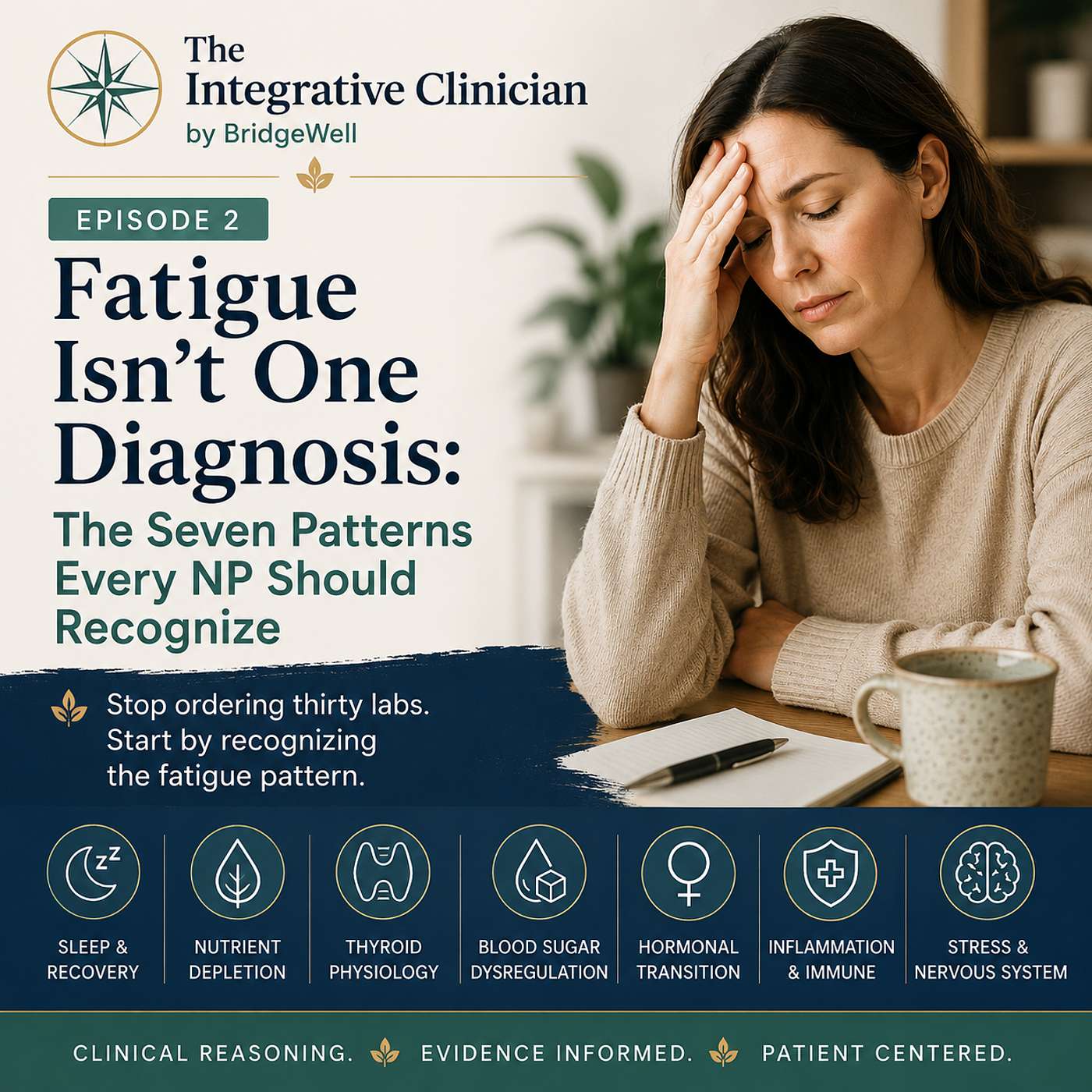
A 47-year-old woman comes in for fatigue, weight gain, brain fog, and disrupted sleep. Her thyroid panel is within normal limits. Her CBC is unremarkable. Her metabolic panel is fine. Conventional medicine says: labs are normal, reassure, and follow up.
An integrative clinical lens says: something is driving these symptoms. What is her cortisol pattern? What is her gut doing? Is there an inflammatory driver? What does her metabolic picture look like beyond the standard panel?
You are not replacing the conventional workup. You are extending it. You are asking additional questions, looking at additional patterns, and connecting dots across systems that conventional training put in separate boxes.
The Three Things You Actually Need to Practice Differently
In my 25 years of clinical practice and 16 years of teaching NPs, I have seen a consistent pattern in what separates the NPs who successfully integrate functional medicine thinking from the ones who collect courses and still feel stuck.
First, a clinical reasoning framework. Not protocols for specific conditions, but a way of thinking about any patient that helps you decide what to look for, how to prioritize, and where to start. Without this, every complex patient is a different puzzle you are solving from scratch.
Second, systems knowledge with real depth. Not a surface understanding of each body system, but a genuine understanding of how hormones, metabolism, gut health, and neuroinflammation interact, because that is where your complex patients live.
Third, tools that make knowledge usable in practice. The visit templates, the lifestyle prescriptions, the documentation guides, the patient education materials, the things that translate clinical knowledge into action in a real visit with a real patient.
That is what changes clinical practice. Not more information. A better framework for using what you already know.